There are many factors that go into determining the correct fan for a specific application. From salt fog to high temperatures, to changes in altitude – every environmental factor must be carefully considered. Temperatures can drastically drop at high altitudes, but that is not necessarily conducive to keeping key parts cool. Let’s break down why altitude can affect fan performance, and how AMETEK Rotron can help select the right fan for the job.
Why fan performance changes at different altitudes
Fans are designed to move air, measured in
cubic feet per minute (CFM), at a specific speed, tracked in
revolutions per minute (RPM). If we assume constant temperature, a fan moves the same volume of air per revolution regardless of air density.
However, at higher altitudes, the air becomes less dense as there are fewer molecules packed into the same volume of air. This reduced density has a direct impact on the fan's cooling performance since less air mass is available to transfer heat. While a fan’s RPM and CFM might remain constant, the cooling effect diminishes with altitude.
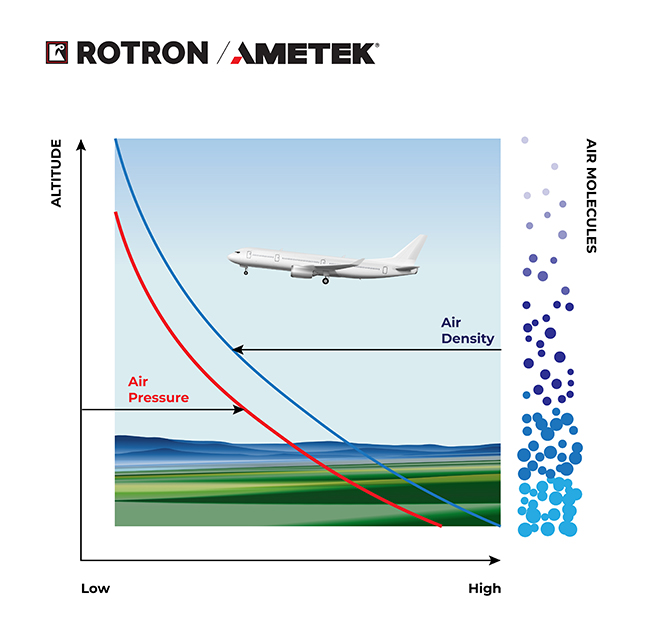 Altitude Example
Here's an example of how air flow requirements can change at different altitudes.
Let’s assume we you have an air flow requirement at 25,000 feet.
340W needs to be removed and the temperature differential is 15°C. We will compare the requirement of flow at sea level and at 25,000 feet.
For informational purposes, at sea level, the density of air is .075 lbs/ft3 (1.19 kg/m3) and at 25,000 feet, the density is .034 lbs/ft3 (0.549 kg/m3).
CFM = Q /(Cp * r * DT)
Q = Heat Transferred (kW)
Cp = Specific Heat of Air
r = Density
DT = Change in Temperature
For degrees Celsius we get the equation below leading to approximately 40 CFM required at sea level.
CFM = 2074 * Q (kW) / (r * DT)
CFMSea = 2074 * (.340kW)/ (1.19 kg/m3 * 15°C))
CFMSea = 39.5 ft3/min
At 25,000 feet we would need approximately 86 CFM required.
CFM = 2074 * Q (kW) / (r * DT)
CFM25000 = 2074 (.340 kW)/ (.549 kg/m3 * 15°C)
CFM25000 = 85.6 ft3/min
What this demonstrates is that cooling the same heat load at altitude requires significantly higher flow. These calculations are key to ensuring proper cooling at all possible elevations.
Selecting the correct fan for the application
With over 75 years of experience, you can trust AMETEK Rotron for a solution that will meet your application’s needs at any temperature or altitude. Our experienced engineers will work with your team to determine the most appropriate fan for your specific application needs.