What is Salt Fog?

In aerospace, every environmental element must be considered. While temperature and altitude are the conditions that most people think of as significant hurdles, salt corrosion is also a serious consideration.
Salt fog is a corrosive mist of salt particles carried by the air, commonly found in coastal or marine environments. If you’re working in environments near the ocean where salt is constantly in the air, you know how quickly corrosion can take over. While salty ocean air can feel great at the beach, salt carried in the air can be detrimental to electronics. Damage can occur to various surfaces once the particles settle.
Because many aerospace applications operate near or over oceans, or are subjected to extreme environmental conditions, salt fog resistance is a crucial part of ensuring the longevity and reliability of a system. When fans are exposed to salt fog, the particles can penetrate the fan’s internal components, including the motor and electronics and other metal components.
How Does Salt Fog Affect Electronics?
For components exposed to harsh environments—like fans and blowers—corrosion resistance is an essential part of a fan’s design. Salt fog or spray is one of the most corrosive environmental challenges for electronic systems, posing a risk to internal fan electronics. Without adequate protection, salt fog could ultimately lead to complete fan failure.
When combined with moisture, salt becomes corrosive, eating away at metal surfaces like circuit connections and terminals. Over time, this corrosion can weaken or even break connections, leading to performance issues or outright failures.
As salt particles accumulate, they can bridge gaps in circuitry, causing unintentional connections. This buildup can create paths for electrical current where it’s not intended to go, leading to short circuits and potentially damaging components or even causing system failures.
Salt particles can also infiltrate the fan motor, especially if there’s no protective coating or sealing. When the moisture evaporates, the salt can recrystallize on motor components, eventually gumming up the mechanics. This crystallization can lock the rotor in place, preventing it from spinning—also known as a locked rotor state.
"Salt fog or spray is one of the most corrosive environmental challenges for electronic systems, posing a risk to internal fan electronics."
How Does Rotron Combat Salt Fog?
As co-creators of the MIL-STD-810 standard, Rotron has extensive experience in designing to meet and exceed these requirements. Our in-house testing facilities ensure that our methods reduce the effects of salt fog are effective.
A fan in our salt fog chamber in Woodstock, NY
Coating and Sealing
We apply corrosion-resistant coatings to protect internal electronics and structural components from salt exposure. To resist saltwater intrusion, we offer options for sealing and completely potting electronic components, creating an additional barrier against corrosion.
Drainage Features
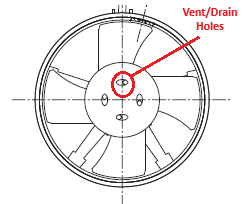
In designs with inverted motors, we incorporate drain holes to prevent water collection, which reduces the likelihood of saltwater crystallizing within the motor.
Locked Rotor Protection
If crystallization does occur, our locked rotor protection circuits limit the current in the event of a locked rotor state, protecting the motor and electronics until the unit is safely powered down.
For more information, get in touch with one of our engineers by filling out our contact form.