What is a performance curve?
A performance curve is a graphical representation of a fan or blower’s aerodynamic behavior. It shows the relationship between static pressure and volumetric flow rate. This curve helps engineers understand the fan’s most efficient operating point. Engineers use performance curves to ensure that the selected fan will meet a system’s requirements.
Understanding the Graph Elements
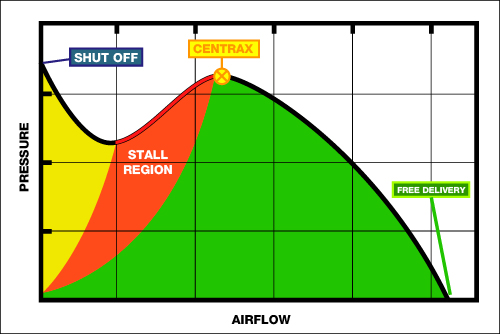
Centrax
The centrax is the point of inflection where the slope inverts.
The area to the right of the centrax is the most desirable region of operation. To the left of the centrax is the
stall zone. A fan operating in this region would behave erratically.
Free Delivery
The intersection of the performance curve and the x-axis is called Free Delivery. This is the volumetric flow rate the fan will produce if it is operating completely unimpeded in open air.
Shut Off Point
The intersection of the curve at the Y-axis is called the Shut Off point. This is the amount of pressure where the fan will no longer be able to provide airflow through the system as it reaches equilibrium.
Reading the Graph
Now that you understand the elements of the graph, let’s use it to determine if a fan would work for your application. To begin, plot your performance point on the fan performance curve.
System Impedance
The system impedance is the resistance a system presents to the flow of air, which affects the performance of a fan or blower. It encompasses all factors within the system that restrict airflow, such as ducting, heat exchangers, filters, and other obstructions such as grilles, valves, or anything else that would disrupt the air’s path. System impedance is represented as a curve that shows how resistance increases with airflow. To determine the operating point of a fan in a system, engineers need to know the system's impedance curve.
System Impedance Equation
P=K×ρ×〖CFM〗^n
Depends only on CFM at a given altitude
n≈2 for turbulent air
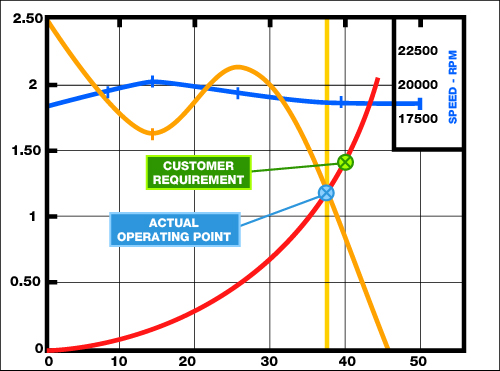
The impedance curve can be approximated using a French Curve as demonstrated in the graphic.

Find the intersection point of the system impedance curve and the aero performance curve.
This is the actual operating point of the fan when it is installed in your system.
From here, draw a vertical line through the actual operating point. Follow this up to the speed curve and find the intersection. This is the rotational speed of the fan at that operating point.
You can follow the vertical line down to its intersection with other curves that may be listed such as efficiency, current input, power, internal temperature rise etc.
If the actual operating point of the fan exceeds your design point and is to the right of the centrax, this fan will work for your system.
In some cases, a fan’s actual operating point might fall below the customer’s requirement, but the fan could still be a viable option. In the below example, the actual operating point is only a few CFM short of the requirement. If this is within the acceptable margin of tolerance, the customer might be able to utilize this fan with the benefit of a lower power draw and reduced noise.
Accounting for Other Variables
Keep in mind system features such as filters that may clog over time and change the system impedance.
This should be accounted for during the selection process.
Plan for the clean and dirty delta P of the filter to ensure the dirty delta P has an actual operating point that is still to the right of centrax and outside of stall.
It should be noted that a fan will operate safely to the left of the stall region, however it is not an efficient zone and is generally avoided for new product selections
If you have questions about finding the perfect cooling fan solution for your system, please reach out to our engineering team for assistance.