Solving the Fan Control Challenge in a System
While fan cooling effectively addresses many thermal challenges, it can also introduce secondary issues during installation. These secondary issues can come in the form of extra noise, extra power draw and/or lower operating life – all due to the cooling fan meeting a cooling requirement via fixed speed operation.
In many designs, thermal management must consider worst-case scenarios, which may occur only occasionally. In such cases, adjusting the fan’s rotational speed can help minimize these secondary effects. Controlling the rotational speed of the fan can often reduce the impact of those secondary issues.
Rotron’s brushless DC fans include motor controllers that can accommodate system inputs ranging from via simple 0-5 VDC input signals that correspond to fan rotational speed (i.e. 2.5VDC = 50% rotational speed of the fan) all the way to being able to interact with various communication networks (RS 485, etc.).
The question is: how can we manage or control a basic AC fan, whose rotational speed is inherently fixed by the frequency of the AC power supply due to its induction motor design?
How Rotron is Engineering VFDs for our Fans
Traditional speed control methods often require extensive engineering changes to each fan, increasing cost and complexity. However, Variable Frequency Drives (VFDs) are scalable and can be tailored to fan family power levels. Paired with AC to DC converters, VFDs offer a streamlined, modular solution able to interface with RS-485, CANBUS, Ethernet, etc.
Through the pairing of an AC fan and VFD drive, the cooling solution can now be tuned to meet specific performance requirements and controlled to reduce operating speeds based on system cooling needs at that time. This results in:
- The efficiency of the fan is maximized across a range of different operating conditions.
- Noise levels are reduced, since the RPM can be lowered when full power isn’t necessary.
- Energy consumption is reduced due to lower operating speeds.
- Simplifies system controls via the use of logic level interface to control fan speed.
Rotron’s approach simplifies this by offering a plug-and-play module or fan-mounted system that accepts AC or DC input and handles the rest.
Fan speed can be precisely controlled in percentage increments of their maximum RPM. These fans are designed to operate reliably in inhospitable environments, while the Variable Frequency Drive can be installed separately in a more protected location. By leveraging this technology, simple fans can more readily meet MIL-STD-810 qualification standards, while the VFDs can be strategically located in protected environments to shield them from EMI and other environmental stressors.
When space is a concern, VFDs can also be mounted directly to the fan.
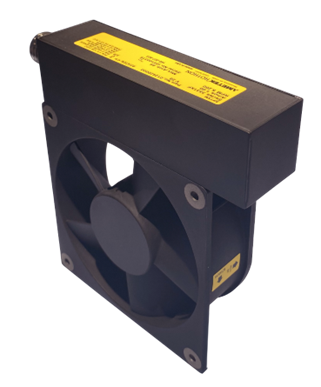 A Rotron fan with a VFD attached
Rotron has developed specialized VFD modules for unique applications. Additionally, Rotron has an ongoing effort to create modular VFDs that can be used in various new applications.
VFD controlled fans are ideal for engine ventilation, avionics and electronics cooling, and land and naval applications that require rugged cooling solutions. They can also be used in the semiconductor industry on high-performance cooling fans with overspin capabilities and high MTBF ratings.
These fans are currently qualified to or can be designed to meet DO-160 and MIL-STD 810 standards, ensuring durability in harsh conditions. Whether it’s reducing acoustic signatures or optimizing power draw, VFDs represent a major leap forward in electronics cooling.