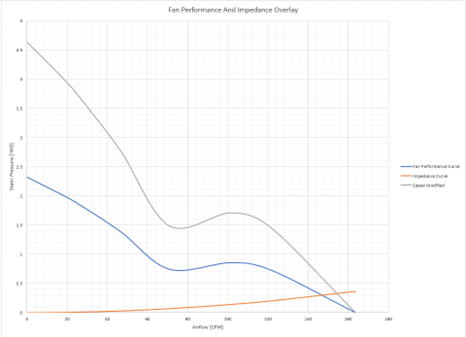
While a single fan can effectively meet many airflow and pressure requirements, certain applications may benefit from multi-fan configurations. By arranging fans in series or parallel, engineers can tailor airflow and pressure characteristics to better suit specific needs. These two configurations can be used in any application, assuming that there is space to accommodate additional fans.
Series vs Parallel Configurations
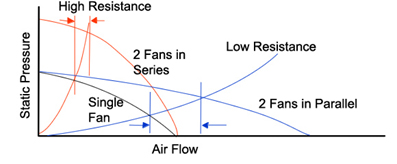
Fans in series will increase the shut-off pressure to twice that of a single device. Using fans in series is ideal for high-resistance systems where pushing air through tight spaces or filters is critical. However, fans in series will not increase the maximum airflow.
Setting two fans in a
parallel configuration will double the airflow while the pressure level remains the same. This configuration is well-suited for low-resistance systems where moving large volumes of air is the priority.
Note that at intermediate flow points, the flow and pressure increases, and whether fans should be in series or parallel depends upon the degree of system resistance, i.e. placing two air movers in series in the low resistance system shown would produce a negligible increase in flow and pressure.
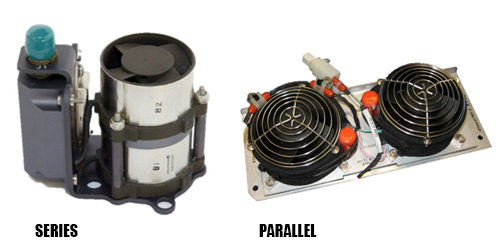
Configuring units in either series or parallel operation can also add system reliability. For example, some customers decide to use two parallel fans in their system to provide redundancy in the event of an unforeseen system failure.
When applying more than one fan in a system:
• "n" fans in series will increase pressure "n" times at a given flow rate, with no additional free delivery flow.
• "n" fans in parallel will increase flow "n" times at a given pressure level, with no additional shutoff pressure generated.
Configuring units in series or parallel gives customers greater flexibility when designing their systems. With Rotron’s extensive catalog of documented part numbers and product families, we can typically identify combinations that meet performance goals without requiring new part development. This approach allows customers to maintain the reliability and consistency of Rotron products while achieving enhanced airflow or pressure, without the added complexity of introducing new part numbers.
How Series and Parallel Configurations Change Performance
Below are 2 examples of Rotron fans in series and parallel to demonstrate the performance of each configuration.
Two 20000RPM AX2 fans in parallel
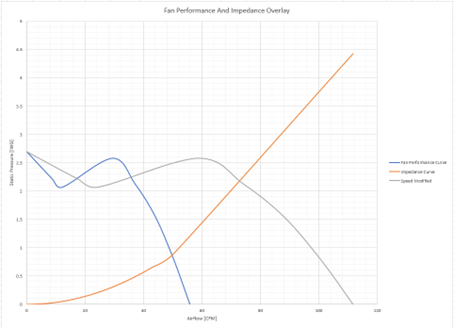
2 fans in parallel generate 70 cfm while a single fan generates 50, which is a 40% increase in cooling airflow.
Two 20000RPM AX2 fans in series
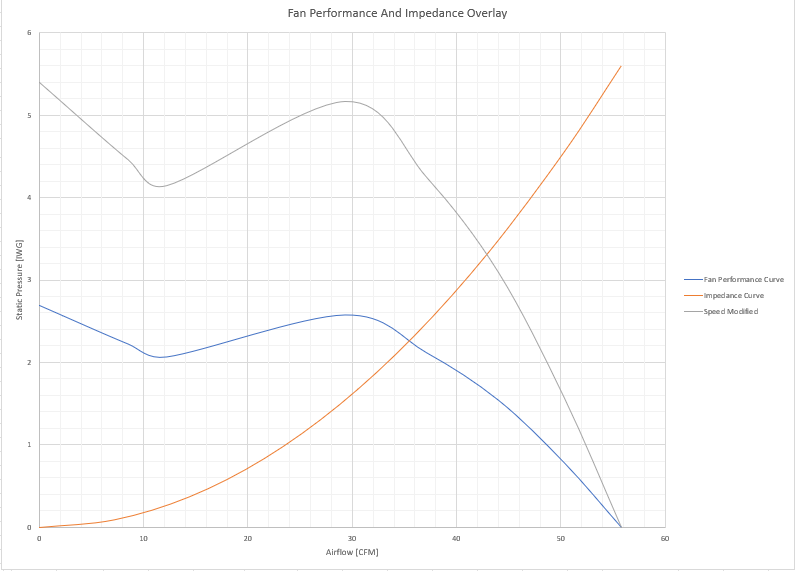
Here we see a ~23% improvement and full redundancy.
Two 10000RPM PX3B fans in parallel
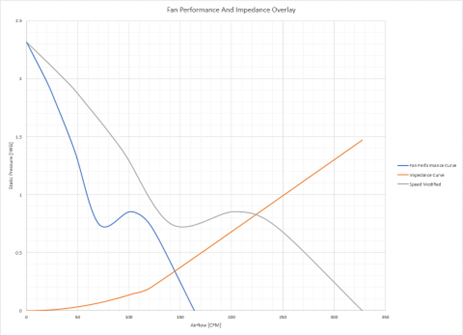
2 fans in parallel generate 220 cfm while a single fan generates 140, which is a ~60% increase in cooling airflow.
Two 10000RPM PX3B fans in series